



Free your CX from billing constraints

By Convey News
April 8, 2026 5 min read
Share this post
news icon

Customer experience leaders in utilities know the feeling. You’ve identified a better way to reach customers before they fall behind on payments. Your team has mapped the journey, written the messages, and aligned on the channels. Everything is ready to go. 

And then it stalls. 

Not because the idea isn’t sound, but because the execution depends on your billing system’s next release cycle. 

When customer experience is tied to infrastructure, progress slows 

In many utilities today, customer engagement capabilities are still embedded within core systems like CIS, billing, OMS, and ERP. That structure made sense when these platforms were first designed. But today, it creates a bottleneck. 

When outbound messaging, journey orchestration, and communication logic live inside your billing platform, every improvement to the customer experience becomes dependent on infrastructure timelines. A simple update to a payment reminder journey can end up waiting months, competing with regulatory updates, rate case changes, and system integrations. 

The result is a mismatch. The teams responsible for designing thoughtful, empathetic customer experiences are operating on a completely different cadence than the systems required to deploy them. 

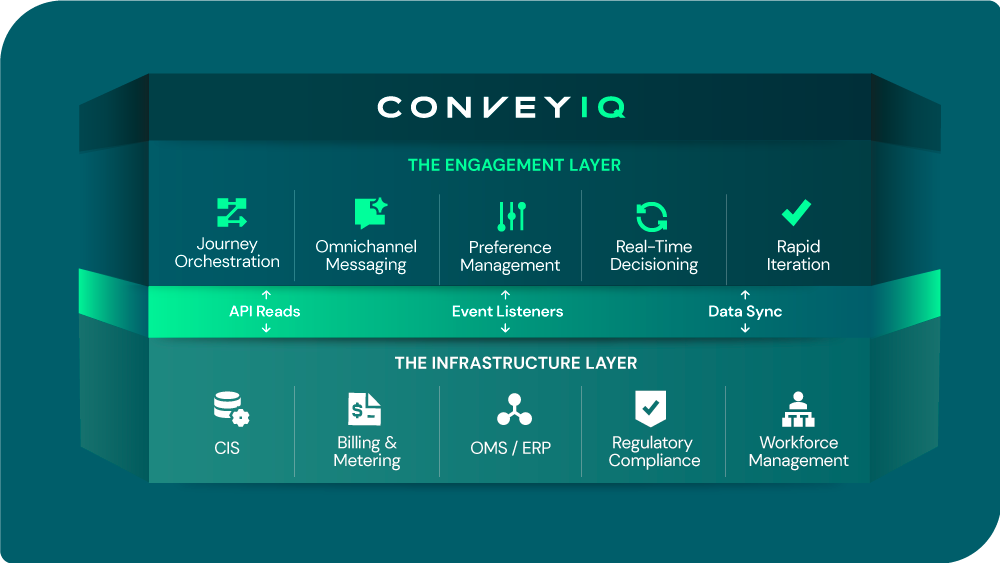
ConveyIQ  is an engagement layer that sit above your existing infrastructure.
ConveyIQ works by layering itself over your existing infrastructure. This independent engagement layer takes information from the infrastructure layer while avoiding being constrained by it, meaning your teams are able to launch purposeful and agile communications to your communities without running into the traditional bottleneck.

Two layers, built for two different purposes 

Your infrastructure layer plays a critical role. It ensures accurate billing, regulatory compliance, and operational stability. It should move carefully and deliberately. 

But your engagement layer should move differently. 

By separating engagement from infrastructure, utilities create an independent layer that can read from systems of record without being constrained by them. This allows teams to design, test, and launch new customer journeys on their own timeline. 

A new SMS touchpoint in a collections journey should not require a CIS change request. It should be something your team can deploy in days, not months. 

What separation unlocks 

Decoupling engagement from infrastructure is not just a technical shift. It has real, measurable impact across the business. 

Speed 

Testing and optimizing customer journeys becomes faster and more iterative. What once took months can now happen in days, enabling continuous improvement. 

Cost efficiency 

When engagement is bundled into core systems, even small updates often require expensive implementation resources. Separating the layers ensures that customer experience work is done in the right environment, at the right cost. 

Resilience 

An independent engagement layer provides flexibility during large-scale system changes. Utilities can modernize or replace their CIS without disrupting active customer communications. 

Better use of talent 

Designing customer journeys and configuring billing systems require very different skill sets. Separating these functions allows each team to focus on what they do best, without being constrained by shared governance models. 

A better way forward 

This is not about replacing the systems you rely on today. Your core infrastructure should continue to do what it does best. But it is worth asking: should your ability to reach a customer at the right moment, with the right message, depend on a billing system release cycle? 

Your customers don’t experience your systems of record. They experience how and when you communicate with them. When engagement operates independently, you gain the flexibility to meet customers in real time, adapt quickly, and continuously improve the experience you deliver. That’s how modern utilities move from reactive communication to proactive engagement. 

If you’re rethinking how your organization approaches customer engagement, it may be time to consider what a decoupled model could look like for you.

Frequently asked questions (FAQs)

What does it mean to decouple customer experience from billing systems?
It means introducing an engagement layer like ConveyIQ that sits above your core systems. Instead of embedding communication logic inside billing or CIS, ConveyIQ reads data from those systems and activates it through intelligent workflows, giving your team control over when and how you engage customers.

Do we need to replace our CIS or billing platform to use ConveyIQ?
No. ConveyIQ is designed to integrate with your existing systems, not replace them. It operates at the data and event layer, allowing you to modernize engagement without disrupting your infrastructure.

What makes ConveyIQ different from traditional messaging tools?
Traditional tools focus on sending messages. ConveyIQ focuses on decisioning. It evaluates customer context, compliance requirements, and journey state to determine the right message, channel, and timing before anything is sent.

How does ConveyIQ handle compliance and consent?
Compliance is embedded directly into every workflow. ConveyIQ checks consent status, regulatory rules, and contact policies before a message is sent, ensuring communications are both timely and compliant without adding manual effort.

How does ConveyIQ help teams move faster?
With configurable workflows instead of custom development, teams can launch new journeys quickly using pre-built templates for common utility moments like billing notifications or outage updates. Many utilities can get started in just a few weeks and expand from there.