



Building a storm-ready communication strategy: How LG&E and KU scaled proactive engagement

By Convey News
April 20, 2026 6 min read
Share this post
case study icon
Building a storm-ready communication strategy: How LG&E and KU scaled proactive engagement

For utilities serving large, diverse service territories, storm communication is not just an operational necessity. It is a trust-building function that customers rely on in critical moments.

LG&E and KU, serving more than one million customers across Kentucky and Virginia, operates in a region with frequent and severe summer and winter storms. With high customer expectations for reliability and transparency, the organization recognized that reactive, one-off notifications were no longer enough.

At this scale, communication needs to be structured, repeatable, and resilient under pressure.

The shift to proactive engagement

At the end of 2025, LG&E and KU took a significant step forward by enabling proactive SMS capabilities through Convey. By January 21st, 2026, SMS was fully activated for customers, creating a new foundation for real-time, direct communication during service events.

This shift was not just about adding a channel. It was about operationalizing a consistent engagement model that could perform during high-impact scenarios.

Putting strategy into practice: Winter Storm Fern

Just days after SMS activation, Winter Storm Fern hit on January 24th, 2026, bringing ice, snow, and extreme cold across the service territory.

The timing created an immediate, real-world test of the new communication strategy.

Using Convey, LG&E and KU:

  • Notified 740,000 customers about the new SMS capability
  • Supported more than 25,500 impacted customers during the storm
  • Delivered over 59,000 proactive outage messages

More importantly, they executed against a clear, repeatable communication cadence:

  • Initial notification at the start of the event
  • Updates every two hours or when estimated restoration times (ETRs) changed
  • Confirmation messaging upon service restoration

In sustained storm conditions, they maintained “storm mode” operations, ensuring at least one message per day to affected customers.

This structured approach ensured that customers were never left wondering what was happening, even as conditions evolved.

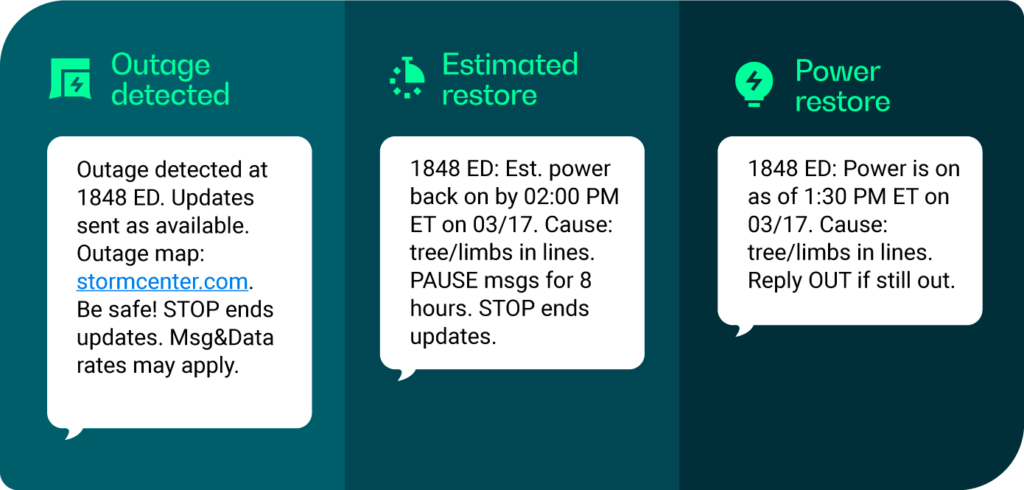
Real examples of communications that LG&E and KU have sent to their customers
Real examples of communications that LG&E and KU have sent to their customers when hit with outages. Clear and consistent communication encourages trust in the communities they serve.

Managing edge cases: Transformer failure event

On January 27th, 2026, just days after Winter Storm Fern, extreme cold conditions led to a localized transformer failure impacting approximately 350 customers.

While smaller in scale, this event required a different communication approach.

With extended restoration times exceeding 24 hours, LG&E and KU used Convey to deliver targeted, transparent messaging that explained the unique circumstances and set clear expectations.

This ability to shift from broad, high-volume messaging to precise, situation-specific communication highlights the importance of flexibility within a structured framework.

Key takeaways

LG&E and KU’s experience reinforces several critical principles for modern utility engagement:

  1. Proactive communication must be operationalized, not improvised
    Having tools in place is not enough. Defined cadences and workflows ensure consistency when it matters most.
  2. Scale demands structure
    Reaching hundreds of thousands of customers requires a repeatable model that can adapt without breaking under pressure.
  3. Transparency builds trust during uncertainty
    Frequent, clear updates, especially when timelines change, help reduce frustration and improve customer confidence.
  4. Flexibility is essential for real-world conditions
    Not every event fits the same pattern. The ability to tailor messaging for unique scenarios is just as important as managing large-scale outages.
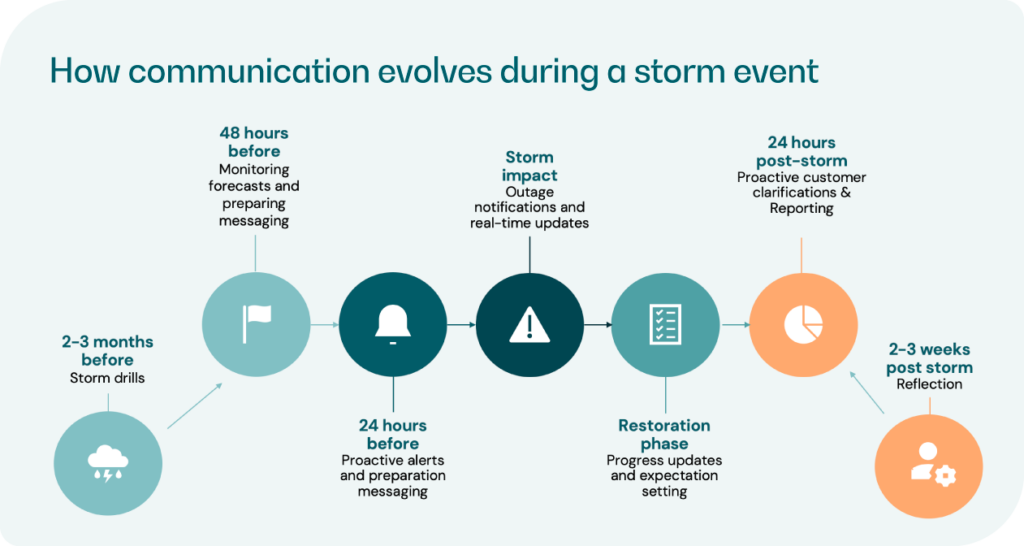
A timeline on how communications evolve during a storm
Communication needs evolve throughout the lifecycle of a storm. Proactive utilities are prepping 2-3 months beforehand with storm drills with their internal teams and preparing messages in advance. After the storm, they are reflecting on their actions and understanding how their communities responded in order to better serve them in the future.

Moving forward

Storms are inevitable. Customer expectations are only increasing.

By combining proactive SMS, structured communication cadences, and intelligent workflows through Convey, LG&E and KU have established a model for engagement that is not only responsive, but resilient.

Watch on-demand: Built for the storm: LG&E and KU’s strategy for proactive communication with Convey

This session explores the critical shift happening across the utility industry, where storm response is no longer just about restoration, but about how effectively you engage customers throughout the event.

You’ll learn how to:

  • Continuously improve your approach with post-event insights and refinementustration.
  • Build a proactive communication strategy that reduces inbound call volume and improves customer satisfaction
  • Operationalize storm readiness with pre-approved messaging, defined workflows, and team alignment
  • Deliver the right message at the right time across SMS, email, and voice channels
  • Use structured communication cadences to keep customers informed from outage detection through restoration
download

Download the case study

Open a shareable PDF version of the case study, ready to download and circulate across your teams.

Frequently asked questions (FAQs)

Why is storm communication so critical for utilities today?
Storm communication has become a core part of how utilities build and maintain trust. For organizations like LG&E and KU, serving large and diverse territories, customers expect timely, transparent updates during outages. With Convey, they are able to deliver clear, consistent communication that reduces uncertainty, lowers frustration, and reinforces confidence in their response.

What does it mean to move from reactive to proactive communication?
Reactive communication responds after customers experience an issue. Proactive communication anticipates their needs, delivering updates before customers have to ask. LG&E and KU made this shift by using Convey to enable proactive SMS, allowing them to notify customers when an outage begins, provide regular updates, and confirm restoration through a structured, repeatable approach.

How can utilities manage communication at scale during major storm events?
At scale, communication must be structured. During Winter Storm Fern, LG&E and KU used Convey to reach hundreds of thousands of customers with a defined cadence, including updates every two hours or when restoration times changed. This repeatable model helped their teams stay aligned and responsive, even under pressure.

How should utilities handle unique or smaller-scale outage events?
Not every outage follows the same pattern. In a localized transformer failure, LG&E and KU used Convey to deliver targeted, transparent messaging to affected customers, especially as restoration timelines extended. This flexibility allowed them to adapt communication to the situation while maintaining clarity and consistency.

What does a modern storm communication strategy look like?
It spans the full lifecycle of a storm. With Convey, LG&E and KU prepare in advance with drills and pre-approved messaging, execute with real-time, proactive updates during events, and refine their approach afterward using insights and performance data. The result is a communication model that is not only responsive in the moment, but continuously improving over time.