
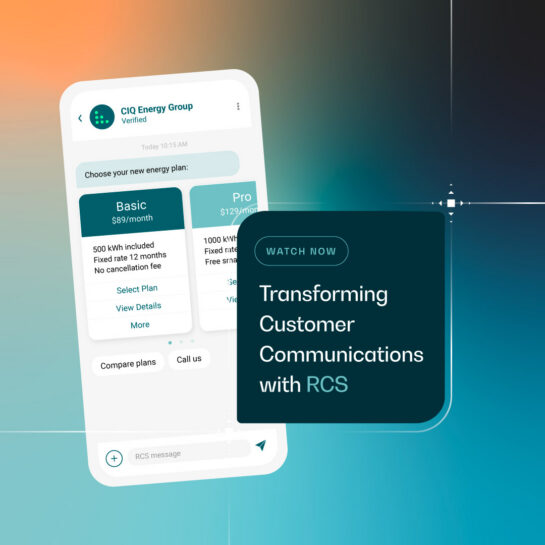


Watch now: Transforming customer communications with RCS

By Convey News
June 10, 2026 4 min read
Share this post
news icon
Watch now: Transforming customer communications with RCS

Rich Communication Services (RCS) is changing the future of customer engagement, and utilities have a unique opportunity to take advantage of it. In this webinar, Convey’s Senior Product Manager Susan DeClerck and Account Executive Kevin Shunk explore how RCS is transforming business messaging by combining the reach of SMS with the rich, interactive experiences customers have come to expect from today’s digital brands. While SMS has served companies well for decades, customer expectations have evolved. Customers increasingly expect trusted, branded, and interactive experiences that allow them to take action immediately without navigating through multiple websites or applications. RCS delivers exactly that.

During this session, we discuss how utilities and other regulated organizations can leverage RCS to create more engaging customer experiences, increase trust, improve response rates, and gain deeper insights into customer behavior. In this webinar, you’ll learn:

  • Why traditional SMS is becoming less effective as spam, phishing, and message fatigue continue to rise
  • How verified sender identities, branded messaging, and rich media experiences help build customer trust
  • The differences between SMS and RCS, and why RCS is being called the biggest evolution in business messaging in over a decade
  • How businesses can use RCS for billing notifications, outage communications, service updates, payment reminders, program enrollment, and more
  • The role of read receipts, engagement analytics, suggested replies, and one-tap actions in driving customer engagement
  • How RCS enables customers to complete actions directly within the messaging experience
  • Real-world examples of interactive customer journeys and conversational workflows
  • Industry adoption trends, carrier support, and device compatibility across North America and around the world
  • Lessons learned from major brands like Lowe’s and how their phased RCS strategy can be applied to utility customer communications
  • Best practices for launching an RCS program, from use case selection and agent registration to testing, deployment, and optimization

Why RCS matters for businesses

RCS feaures

Customers now compare every communication experience against the best experiences they receive from retailers, healthcare providers, financial institutions, and digital-first brands. RCS helps businesses meet those expectations by providing:

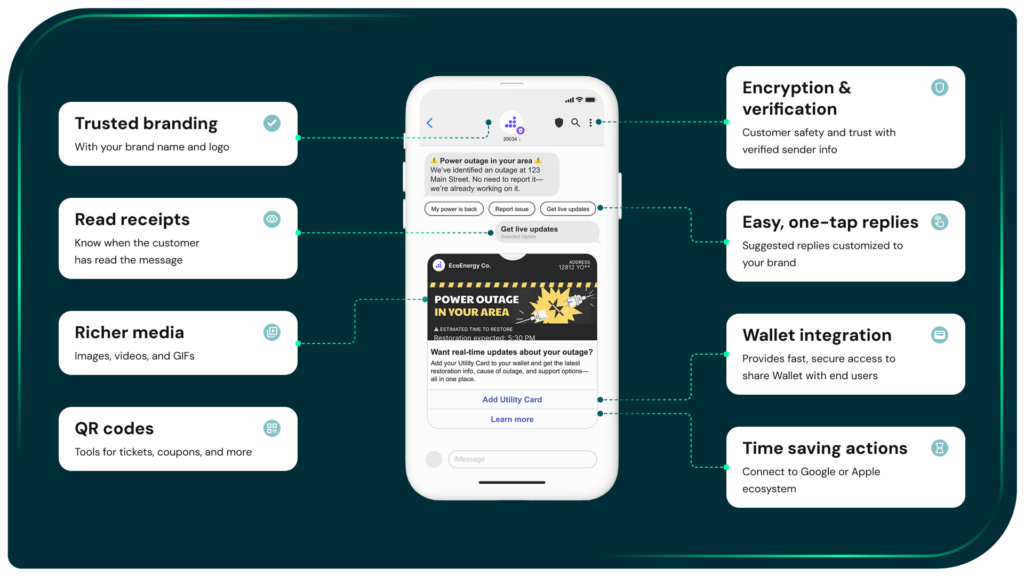
  • Verified sender badges and branded business profiles
  • Company logos and brand colors directly within messages
  • Rich cards, carousels, images, videos, and interactive content
  • Read receipts and advanced engagement analytics
  • Suggested actions and one-tap responses
  • Secure, trusted communication experiences
  • Automatic SMS fallback when RCS is unavailable

The result is a communication channel that drives stronger engagement, builds trust, and creates better customer experiences during critical moments.

  • Rich Communication Services (RCS)
  • SMS modernization
  • Outage communications
  • Billing and payment notifications
  • Customer trust and brand verification
  • Digital customer experience
  • Omnichannel communications
  • Customer analytics and engagement measurement
  • Utility technology innovation
  • Regulatory communications
  • Interactive messaging

Frequently asked questions (FAQs) on RCS for businesses

What is RCS?

RCS (Rich Communication Services) is the next generation of business messaging. It enhances traditional SMS by adding verified sender identities, branded messaging, rich media, interactive buttons, read receipts, analytics, and two-way engagement capabilities.

How is RCS different from SMS?

While SMS delivers basic text messages, RCS enables organizations to send branded, interactive experiences that include logos, images, videos, carousels, suggested replies, and action buttons. RCS also provides engagement analytics such as read receipts and click tracking.

What happens if a customer’s device does not support RCS?

Messages automatically fall back to SMS or MMS, ensuring customers still receive important communications regardless of device or carrier compatibility.

Is RCS available on iPhone and Android devices?

Yes. With recent support from Apple, RCS is now available across both Android and iPhone devices, significantly expanding its reach and making it a viable communication channel for large-scale customer engagement.

What types of communications are best suited for RCS?

RCS is ideal for:

  • Outage alerts and restoration updates
  • Billing notifications
  • High bill alerts
  • Payment reminders
  • Service appointment notifications
  • Program enrollment campaigns
  • Planned maintenance communications
  • Customer surveys and feedback requests

What analytics are available with RCS?

Organizations can track:

  • Message delivery rates
  • Read receipts
  • Click-through rates
  • Suggested action engagement
  • Customer responses
  • Overall campaign performance

These insights help optimize communications and improve customer outcomes.

How difficult is it to implement RCS?

Implementation is typically straightforward when working with an experienced messaging provider. The process generally includes use case definition, carrier registration, branding setup, message design, testing, and deployment.

Can RCS be used alongside existing SMS programs?

Absolutely. Many organizations start with a phased approach, using RCS where supported while maintaining SMS fallback. This allows them to enhance customer experiences without disrupting existing communication programs.

How can utilities get started with RCS?

The best approach is to start with a high-value use case such as billing notifications, outage communications, or payment reminders. Organizations can then expand into more advanced interactive workflows as they gain experience and see results.