


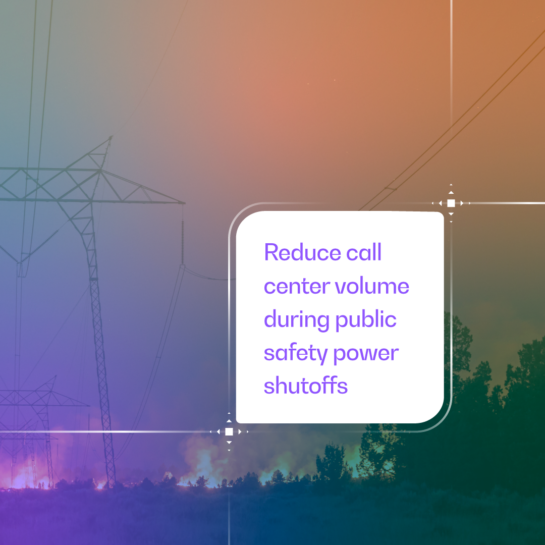

How proactive communication reduced call center volume by 57% during public safety power shutoffs

By Convey News
August 17, 2026 9 min read
Share this post
case study icon
How proactive communication reduces call center volume during public safety power shutoffs

When a public safety power shutoff (PSPS) is declared, utilities have a narrow window to communicate critical information to customers. The challenge is not simply sending a notification. Utilities need to reach affected customers quickly, through the channels and languages they prefer, while prioritizing customers who may have additional needs and keeping contact centers from being overwhelmed.

For one large U.S. utility serving more than five million customers, disconnected tools and manual processes made that challenge even harder. The utility needed a reliable, proactive communication strategy that could reach every affected household before power was shut off.

By implementing Convey’s PSPS solution with high-throughput messaging, the utility delivered more than 9.8 million notifications across 10 PSPS events during a single wildfire season and reduced contact center traffic by 57%.

The communication challenge during a PSPS event

A public safety power shutoff is a proactive de-energization of power lines in high-risk areas designed to help prevent wildfire ignition. Because these events directly affect customers’ access to electricity, timely and accurate communication is critical.

For the utility in this case study, regulators required affected customers to be notified within two hours of the shutoff decision, in their preferred language and channel. With more than five million customers, that created a significant operational challenge.

Manual processes and disconnected communication tools introduced several risks:

  • Gaps in customer outreach
  • Duplicate notifications
  • Inconsistent information
  • Difficulty prioritizing medical baseline and critical care customers
  • Limited visibility into message delivery
  • Significant increases in inbound contact center volume

During a PSPS event, customers naturally have questions. When communication is delayed, inconsistent, or difficult to access, those questions quickly become calls. The solution was not simply to have more contact center agents available. It was to give customers more of the information they needed before they ever picked up the phone.

Moving from reactive support to proactive PSPS communication

The utility implemented Convey’s PSPS solution to automate communication across the full event lifecycle.

Rather than relying on manual outreach through disconnected systems, the utility could coordinate proactive and ad-hoc messaging across voice, SMS, and email.

The approach included:

  • High-throughput messaging: Sustained delivery of up to 900,000 messages per hour, per channel
  • Multilingual communication: Voice, SMS, and email delivered in more than 16 languages
  • Priority outreach: Automatic prioritization for medical baseline and critical care customers
  • Address-level alerts: Notifications for affected locations, including non-account holders
  • Inflight reporting: Delivery reports every 15 minutes so teams could monitor communication status in real time
  • 24/7 support: Access to Convey support within minutes of a PSPS declaration

This approach helped the utility shift from asking, “How do we handle all these calls?” to “How can we answer customers before they need to call?”

Why omnichannel communication matters during a power shutoff

Customers do not all communicate the same way. Some rely on text messages, while others may be more responsive to email or voice calls. During an emergency or planned power shutoff, having multiple communication channels becomes even more important.

For this utility, coordinated voice, SMS, and email outreach made it possible to communicate with customers across more than 16 languages. The utility achieved 97% SMS and email delivery success and more than 85% voice delivery success across every event.

This kind of coordinated communication also helps reduce the risk of customers receiving conflicting information from different systems or teams.

A consistent message across channels gives customers a clearer understanding of:

  • Whether their location is affected
  • When the shutoff is expected
  • What they should do to prepare
  • What the utility knows about the event
  • When they can expect additional updates

The goal is not simply to send more messages. It is to deliver the right information, to the right customer, through the right channel, at the right time.

Prioritizing customers who need more support

Not every customer experiences a power shutoff in the same way. Medical baseline and critical care customers may have additional considerations that require prioritized communication. During a PSPS event, these customers need to be identified and reached quickly. The utility’s communication strategy automatically prioritized these customers, helping teams focus attention where it mattered most.

Address-level alerts also expanded the reach of the communication strategy beyond traditional account-based messaging, helping notify affected locations even when a traditional account relationship was not available.

Real-time visibility helps contact center teams respond faster

Proactive communication can reduce calls, but utilities still need to be prepared for the customers who do reach out.

That makes visibility into message delivery especially important. Convey’s inflight delivery reports provided updates every 15 minutes, allowing agents and utility teams to track the status of customer communications while an event was still underway.

The result was a 40% reduction in average handle time, because agents had better visibility into the customer’s communication status. Instead of spending time determining whether a customer had received an alert, agents could focus on the customer’s actual question or need.

The results: fewer calls and more reliable communication

Across 10 PSPS events during a single wildfire season, the utility delivered more than 9.8 million notifications. The results demonstrated the value of combining high-throughput messaging, proactive outreach, multilingual communication, and real-time delivery visibility.

The utility achieved:

  • 57% reduction in contact center traffic
  • 9.8M+ notifications delivered across 10 PSPS events
  • 900K messages per hour, per channel sustained at peak
  • 98% email delivery rate
  • 97% SMS and email delivery success
  • 85%+ voice delivery success
  • 40% lower average handle time
  • 16+ languages across voice, SMS, and email
  • 100% adherence to regulatory requirements for timing and accuracy

These results demonstrate an important lesson for utilities preparing for wildfire season: proactive communication is not just an emergency notification strategy. It is also a way to reduce operational pressure and give customers more confidence during an uncertain situation.

Preparing for the next PSPS event

Wildfire season can create unpredictable demands for utility teams. Communication infrastructure should not become another variable during an already complex event.

A strong PSPS communication strategy should give utilities the ability to:

  1. Reach affected customers quickly when a shutoff decision is made.
  2. Communicate across multiple channels rather than relying on a single notification method.
  3. Support customers in their preferred languages.
  4. Prioritize vulnerable and critical-care customers.
  5. Monitor delivery in real time.
  6. Provide consistent information throughout the event lifecycle.
  7. Reduce avoidable calls by answering common questions proactively.
  8. Give contact center agents the information they need when customers do call.

When these capabilities work together, utilities can move beyond simply notifying customers about a power shutoff. They can create a communication experience that helps customers understand what is happening, what they should do next, and where they can turn for additional information.

For utilities, that means a safer and more informed community. For contact centers, it means fewer avoidable calls and more efficient interactions. And for customers, it means getting critical information when it matters most.

Communicate before customers need to call

A PSPS event will always create questions. The opportunity for utilities is to answer as many of those questions as possible before they become calls.

With proactive, omnichannel communication, utilities can keep customers informed throughout the event, prioritize those who need additional support, and give contact center teams better visibility when customers do reach out.

The result is a more informed customer and a more resilient utility operation when communication matters most.

download

Download the case study

Open a shareable PDF version of the case study, ready to download and circulate across your teams.

Frequently asked questions about public safety power shutoff communication

What is a public safety power shutoff?

A public safety power shutoff, or PSPS, is a proactive de-energization of power lines in high-risk areas intended to prevent wildfire ignition.

Why is proactive communication important during a PSPS?

Customers need timely information about an impending power shutoff so they can understand what is happening and prepare. Proactive communication can also help reduce the number of customers who need to contact the utility for basic information. In the case study, proactive automated communication contributed to a 57% reduction in contact center traffic.

What channels should utilities use for PSPS notifications?

A PSPS communication strategy can include multiple channels such as SMS, email, and voice. Using coordinated omnichannel communication allows utilities to reach customers through their preferred channels. The utility in this case study delivered voice, SMS, and email communications in more than 16 languages.

How can utilities prioritize medical baseline and critical care customers?

Automated communication workflows can identify and prioritize medical baseline and critical care customers so they receive timely notifications during a PSPS event. The utility’s solution included automatic priority for these customers.

How can proactive PSPS communication reduce call center volume?

When customers receive timely updates before and during a power shutoff, they have more information available without needing to contact the utility. In this case, automated proactive communication helped the utility reduce contact center traffic by 57%.

How does real-time delivery reporting help utility contact centers?

Inflight delivery reports give utility teams visibility into whether communications are reaching customers. In this case, delivery reports were available every 15 minutes, helping agents track live status and contributing to a 40% reduction in average handle time.

How many notifications did one utility send during a PSPS event with Convey?

The solution sustained throughput of up to 900,000 messages per hour, per channel. During one wildfire season, more than 9.8 million notifications were delivered across 10 PSPS events.

What should utilities look for in a PSPS communication solution?

Utilities should look for a solution that can support high-volume communication, multiple channels and languages, customer prioritization, address-level alerts, real-time delivery visibility, and reliable support throughout an event. These capabilities can help utilities communicate more effectively while reducing pressure on contact center teams. Read about Convey’s emergency outage notification solution.