



Wildfire preparedness: A utility guide to proactive communication and community resilience

By Convey News
September 22, 2026 16 min read
Share this post
Wildfire preparedness: A utility guide to proactive communication and community resilience
news icon
Wildfire preparedness: A utility guide to proactive communication and community resilience

Wildfires are becoming an increasingly significant threat for utility providers. For utilities operating in wildfire-prone regions, preparedness now extends far beyond protecting infrastructure and restoring power. It also means having a clear plan for communicating with customers before, during, and after an event.

High temperatures, erratic fire behavior, dense smoke, and rapidly changing conditions can damage grids, substations, and generation facilities, resulting in widespread outages and disruptions. At the same time, customers need timely information they can act on, often while facing evacuation orders, property damage, power loss, and other urgent challenges.

That makes communication a critical part of wildfire preparedness.

The most resilient utilities are preparing months before wildfire season, building cross-functional response plans, testing communication workflows, and creating a consistent cadence for customer outreach. During an event, they are using targeted, omnichannel communication to provide actionable information. Afterward, they are continuing to communicate about restoration, billing support, recovery resources, and what they learned from the event.

This guide explores how utilities can strengthen wildfire preparedness across the full lifecycle of an emergency.

Download now

Get the Wildfire preparedness playbook

Get practical guidance for preparing your utility and keeping customers informed throughout a wildfire event. Use the playbook to strengthen communication plans, anticipate customer needs, and respond with greater clarity and confidence.

Why wildfire preparedness matters

Wildfire response starts long before flames appear on the horizon.

Operational resilience requires utilities to prepare internal teams, establish clear protocols, coordinate across departments, and regularly test their ability to respond under pressure. Annual wildfire scenario planning, all-hazards drills, technology integration, and workforce training can help utilities respond more efficiently when conditions deteriorate.

But operational readiness is only one part of the equation.

Customer communication should be built into the response strategy from the beginning. Utilities need to be prepared to deliver clear, empathetic, and accessible messages throughout the event, while giving customers opportunities to ask questions, report hazards, and provide feedback.

A strong wildfire preparedness strategy can help utilities:

  • Build operational resilience through proactive protocols and cross-functional coordination
  • Deliver rapid, compliant communication at scale
  • Provide consistent and accessible information to diverse communities
  • Strengthen customer trust through transparency and reliability
  • Support broader community resilience before, during, and after an emergency
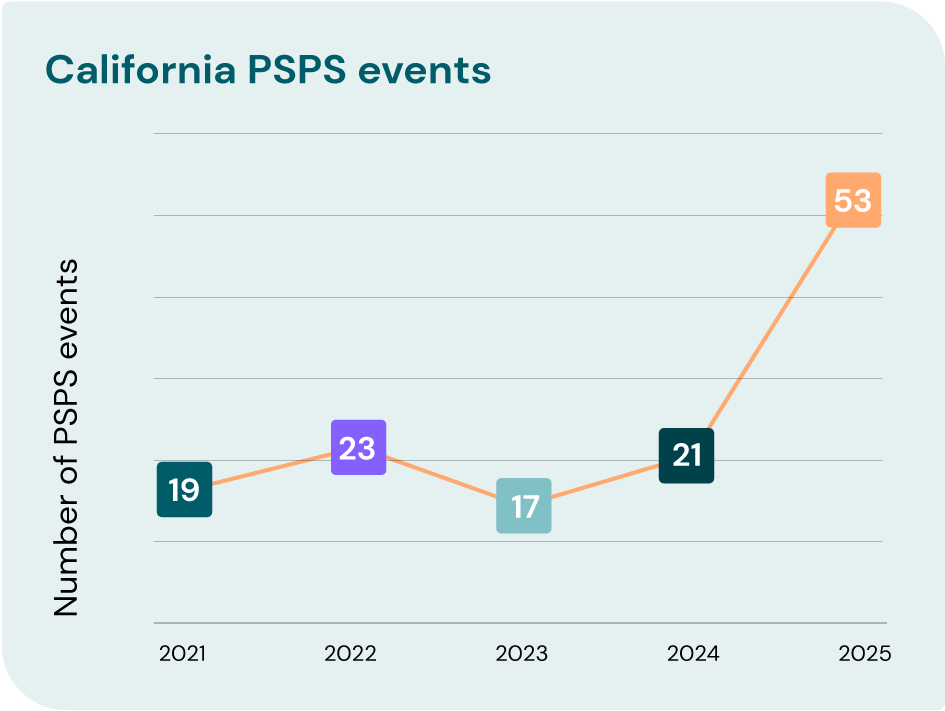
California PSPS graph for 2025
In 2025 alone, nearly four million acres have burned in over 44,000 wildfires nationwide, with power companies across California executing a 145% increase in planned shutoffs to safeguard communities and prevent catastrophic grid failures.

1. Build internal utility readiness before wildfire season

Operational resilience starts before an emergency occurs.

Utilities should maintain detailed wildfire response protocols tailored to regional vegetation, weather conditions, and infrastructure vulnerabilities. These protocols should incorporate lessons from previous fire seasons and regulatory findings.

Establish clear response protocols

A strong response framework should define:

  • Escalation paths between operations and communications teams
  • Shared situational awareness dashboards
  • Regular cross-functional check-ins
  • Coordination processes with mutual aid partners

During a crisis, operations, communications, and customer support teams need to be working from the same information. A clear incident command structure can help keep decision-making aligned as conditions change.

Integrate technology and train key personnel

Technology can support faster decision-making and resource deployment by connecting field and operations teams with real-time information.

Automated alerting systems, crew tracking, and digital dashboards can help teams maintain situational awareness and coordinate response activities more efficiently.

Technology is only as effective as the people and processes surrounding it, however. Utilities should train key personnel on emergency workflows and regularly test their systems before they are needed.

Prepare for PSPS and conservation communications

For utilities in wildfire-prone regions, Public Safety Power Shutoff (PSPS) protocols and conservation appeals should be integrated into wildfire operational plans.

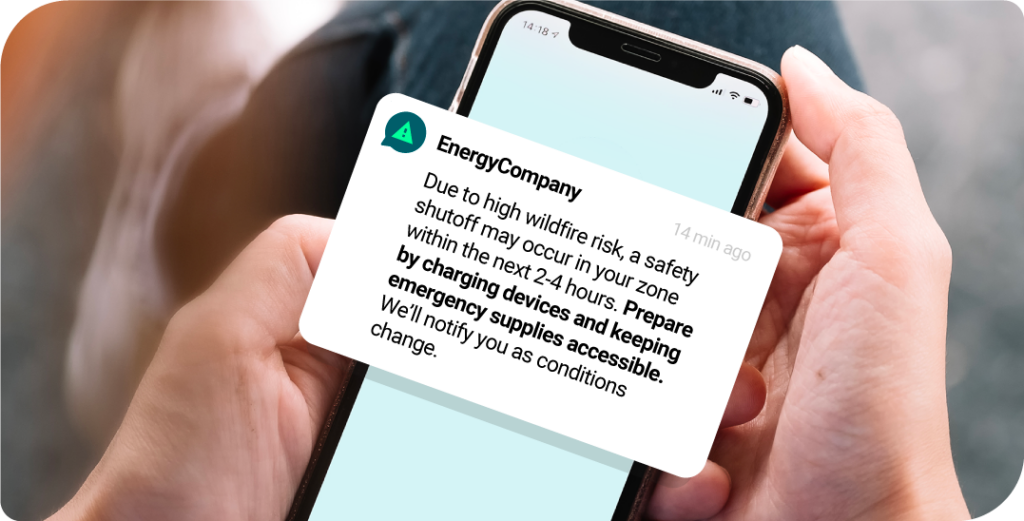
One important step is creating a library of pre-approved, multi-channel messages for conservation appeals, outages, PSPS events, and other wildfire scenarios. Having these messages ready can help teams move quickly when conditions change.

These messages should also be reviewed before each wildfire season so language remains clear, current, and actionable.

Wildfire SMS example from a utility

Support employees and establish mutual aid

Wildfire response can place significant physical and emotional demands on utility employees. Resilience planning should account for employee well-being, including fatigue management, resilience training, and access to appropriate support resources.

Utilities should also maintain mutual aid agreements with neighboring utilities and build relationships with local emergency management organizations, public health agencies, community organizations, and other trusted partners.

These relationships can become especially important when large-scale wildfires require additional crews, equipment, shelters, transportation, or other community resources.

Test the plan

A plan that has never been tested is difficult to rely on during a crisis.

Utilities should conduct annual and pre-season wildfire drills covering scenarios such as fast-moving fires, multi-day outages, and large-scale PSPS events. These exercises can validate emergency communication workflows, mutual aid coordination, and system resilience.

2. Use technology to make crisis communication faster and more targeted

When wildfire conditions change quickly, utilities need communication systems that can keep pace.

Modern engagement technology can help utilities orchestrate rapid communication across SMS, email, voice, chat, and other channels. Targeted messaging can also help utilities communicate differently with customers based on location, evacuation status, grid vulnerability, language preference, or other relevant attributes.

The goal is simple: deliver the right information to the right people at the right time.

Automate emergency communications

Pre-approved workflows can help utilities move from decision to communication quickly. High-throughput capabilities can also become important when large numbers of customers need information at the same time.

The playbook highlights the ability to send more than one million notifications per hour while using intelligent pacing to manage communication volumes during periods of high demand.

Segment communications by risk

Not every customer needs the same message.

Utilities can tailor communications based on factors such as:

  • Location
  • Evacuation status
  • Grid vulnerability
  • Language preference
  • Customer or community segment

This type of segmentation can make emergency messaging more relevant and actionable, particularly when multiple fire incidents or evacuation zones are active at the same time.

Make self-service part of the response

During a major wildfire, customer service teams can experience a surge in questions.

AI-powered chatbots and digital self-service can help customers find answers to common questions, access safety resources, and receive updates while allowing live agents to focus on more complex situations.

Utilities can also monitor communication performance through dashboards that show message volume, segmentation, and delivery success. This visibility can help teams adjust their strategy as an event unfolds.

3. Build trust through transparency and consistency

During a wildfire, uncertainty is unavoidable. Lack of communication doesn’t have to be.

Proactive and consistent updates can help customers understand what is happening, what the utility is doing, and what they should do next.

The playbook identifies several principles for trust-building communication.

Communicate proactively

Customers should not have to repeatedly search for information about their outage or restoration status.

Regular updates, including updates that simply confirm there is no new information, can provide reassurance and demonstrate transparency.

Set clear expectations

If a utility tells customers they will receive another update within a certain timeframe, that commitment matters.

Consistent communication helps establish reliability even when restoration estimates or emergency conditions remain uncertain.

Lead with empathy

Wildfires can create significant stress, disruption, and uncertainty.

Customer messages should acknowledge that reality while providing clear, actionable information. Empathetic communication can help reduce frustration and reinforce the utility’s role as a trusted community partner.

Communicate across channels

Customers have different communication preferences and accessibility needs. Utilities should use a mix of channels, including SMS, email, voice calls, mobile apps, and digital signage, to reach customers where they are.

This approach is consistent with Convey’s broader approach to proactive utility engagement, where omnichannel communication helps utilities keep customers informed across the experiences that matter most.

4. Prepare customers before wildfire threats emerge

Wildfire communication should not begin when the fire starts.

Before wildfire season or when fire risk is elevated, utilities can use their communication channels to distribute preparedness information, encourage customers to update their contact information, and promote emergency notification enrollment.

Preparedness campaigns can include:

  • Wildfire preparation checklists
  • Evacuation routes and shelter information
  • Air quality guidance
  • Generator safety reminders
  • Emergency contact information
  • Property protection tips
  • Energy conservation guidance
  • Information about PSPS events
  • Resources for vulnerable customers

The playbook recommends using channels such as SMS, RBM, email, IVR, app notifications, and digital signage, with targeting based on fire risk zone, customer type, language, and vulnerability status.

Convey’s Digital Wallet Card can also provide a persistent mobile connection for outage, weather, billing, and other critical updates without requiring customers to open a separate app.

5. Communicate in real time when a wildfire threatens

When an active wildfire is underway, communication becomes part of the safety response.

Customers need timely, accurate, and actionable information. They also need to know where to find additional resources and how to contact their utility if their circumstances change.

Use the right channel for the message

Different channels serve different purposes:

SMS can deliver urgent safety and restoration updates quickly.

Voice and IVR can provide auditory updates for customers who prefer or require them.

Email can support longer messages, safety information, and resource links.

App and push notifications can provide real-time updates.

Digital signage can extend communication into public spaces, shelters, and community centers.

A coordinated approach allows utilities to reach more customers while respecting individual communication preferences.

Make communication inclusive

Wildfire communication needs to account for language and accessibility.

The playbook recommends translation, accessible formatting, and multiple communication channels so customers with different abilities and language preferences can receive information they can understand and act on.

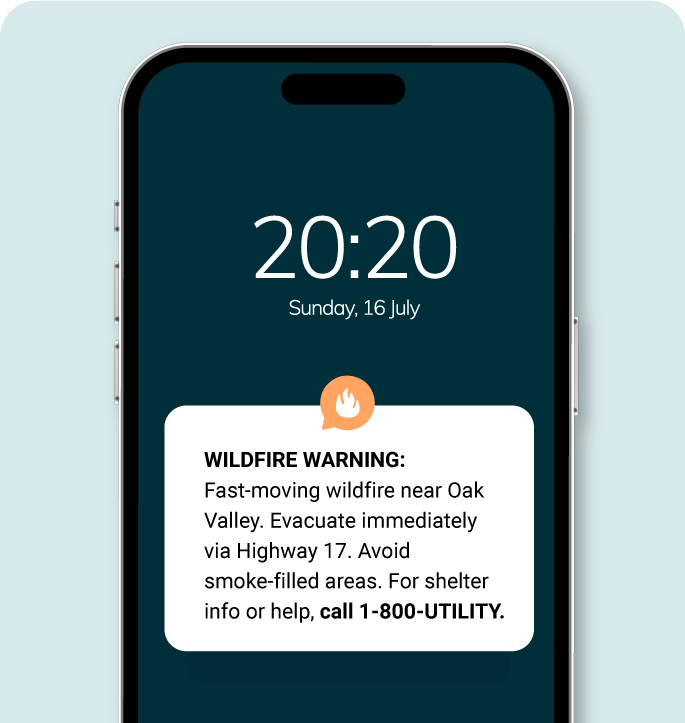
Location-based messaging can also provide customers with guidance specific to their neighborhood or risk zone, such as evacuation instructions or shelter information.

Wildfire message example from a utility company

6. Move beyond one-way alerts with two-way engagement

Emergency communication doesn’t have to stop with sending a notification.

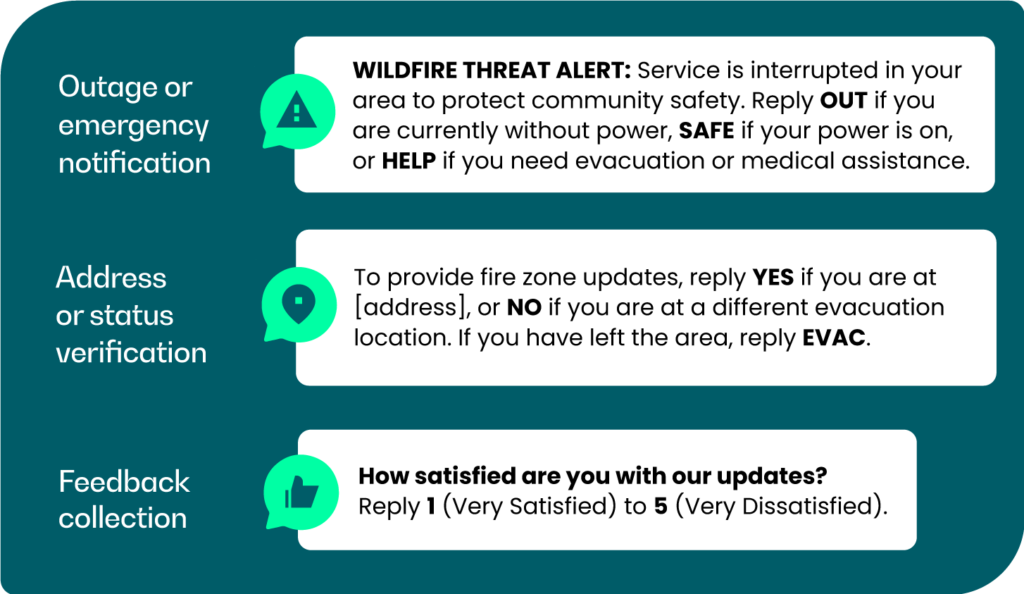
Two-way engagement gives customers a way to respond, report hazards, confirm their status, and request support.

During a wildfire, customers may be able to:

  • Report downed lines, smoke, fires, or other hazards
  • Confirm that they are safe
  • Request evacuation assistance
  • Receive personalized restoration information
  • Provide feedback about the communication experience

This creates a continuous flow of information between the utility and the community.

Customer reports can provide location-specific insights that support damage assessment and crew prioritization. Wellness check-ins can help utilities identify customers who may need additional assistance. Feedback can also help teams adjust messaging cadence and content as conditions change.

Examples of two-way messages

Convey’s current outage management approach similarly emphasizes proactive communication before, during, and after an outage, including opportunities for customers to provide feedback and manage communication preferences.

7. Prepare communication workflows for every stage of a wildfire

Wildfire conditions can change quickly. Utilities should have scenario-based communication workflows ready to deploy.

These may include:

  • Safety alerts
  • Evacuation notices
  • Downed-line warnings
  • Outage notifications
  • Restoration updates
  • Conservation appeals
  • Grid stability messages
  • PSPS notifications
  • All-clear notices
  • Recovery and return-to-service information

Having these workflows prepared in advance can help teams move quickly without starting from scratch during an emergency.

8. Understand the role of conservation messaging and PSPS

Wildfire response can involve both voluntary conservation and Public Safety Power Shutoffs.

When wildfire risk overlaps with high temperatures or high grid demand, utilities may ask customers to voluntarily reduce electricity usage. These communications should explain what customers can do and why their actions matter.

When conditions become severe enough to meet applicable thresholds, utilities may implement a PSPS event as a precautionary public safety measure.

Customers should receive clear warnings, understand the safety rationale, and continue receiving updates throughout the event.

Conservation messaging can include practical actions such as:

  • Raising thermostats during extreme heat
  • Delaying large appliance use
  • Unplugging unnecessary electronics
  • Using ceiling fans
  • Turning off unnecessary lighting

Clear communication around these actions can help customers understand their role in supporting grid stability and community safety.

9. Keep communication moving through recovery

The end of an immediate wildfire threat does not mean communication should stop.

After a wildfire or PSPS event, utilities need to assess damage, restore service, communicate progress, and evaluate the effectiveness of their response.

Customer communication during recovery can include:

  • Restoration updates
  • Safety reminders
  • All-clear notices
  • Return-to-service instructions
  • Billing or payment support
  • Community resource information
  • Opportunities to report ongoing hazards
  • Additional support for impacted customers

Two-way communication remains valuable during this stage. Customers can report continuing hazards or confirm whether service has been restored, while utilities can gather information that helps shape recovery efforts.

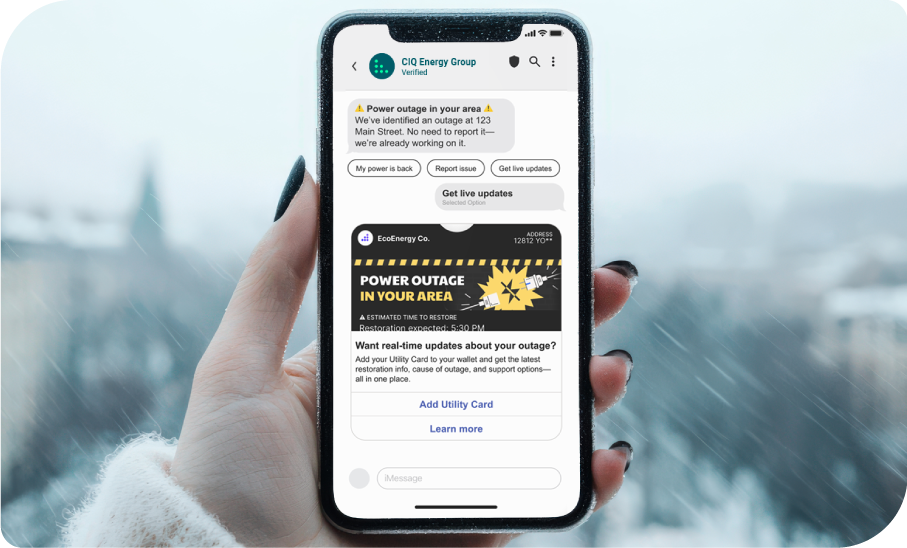
RCS message example of an outage notification

10. Address billing and financial impacts

Wildfires and PSPS events can create financial stress in addition to service disruptions. The playbook notes that utilities may need to communicate billing pauses, payment plans, disconnection protections, and other available assistance to wildfire-impacted customers.

Proactive billing communication can be especially important after a prolonged outage or emergency. Customers should have clear information about available support and where to go for assistance.

A post-event message might explain billing changes, late-fee pauses, flexible payment options, and community assistance resources.

11. Turn every wildfire event into an opportunity to improve

Preparedness doesn’t end when an event is over. Every wildfire provides an opportunity to evaluate what worked, identify gaps, and strengthen the response for the next event.

Utilities should review:

Performance

Audit message delivery metrics, engagement rates, and call center volumes. Compare predicted and actual restoration timelines and review incident command and escalation protocols.

Customer feedback

Post-event surveys such as NPS or CSAT can provide insight into customer perceptions and trust drivers. That feedback can be used to refine messaging cadence, content, and workflows.

Communication templates

Messaging libraries should be updated regularly as new scenarios emerge, regulations change, and customer feedback identifies opportunities for improvement.

The goal is continuous improvement, not simply completing an after-action review.

A wildfire communication strategy should span the full lifecycle

The strongest preparedness strategies connect preparation, response, and recovery rather than treating them as separate activities.

That means:

Before the event: Educate customers, update contact information, promote emergency notification enrollment, share preparedness resources, and test internal workflows.

During the event: Deliver timely, targeted alerts across multiple channels, provide clear safety and restoration information, support two-way engagement, and adjust communications as conditions evolve.

After the event: Continue restoration and recovery updates, communicate billing and payment support, provide safety information, collect feedback, and evaluate performance.

This lifecycle approach is central to modern utility engagement. Convey’s current platform positioning similarly focuses on connecting communications, journey orchestration, analytics, and integrations so utilities can manage customer engagement across critical moments.

Wildfire preparedness checklist for utilities

The playbook’s key takeaways can be distilled into eight priorities:

  1. Start early. Launch preparedness communications before wildfire conditions arrive.
  2. Maintain a consistent cadence. Coordinate communications across pre-event, active-event, and recovery stages.
  3. Test and train. Run wildfire drills and validate emergency workflows.
  4. Humanize every interaction. Lead with empathy, clarity, accessibility, and trust.
  5. Use intelligent technology. Apply segmentation, automation, and rapid omnichannel communication.
  6. Support two-way engagement. Give customers ways to report hazards, request help, and provide feedback.
  7. Make self-service available. Provide access to outage information, PSPS notices, restoration estimates, billing support, and other resources.
  8. Coordinate with community partners. Work with emergency management, first responders, health agencies, and community organizations throughout recovery.

Seven questions to ask before wildfire season

Before the next wildfire threat, utilities can use these questions to assess their readiness:

  1. Are we communicating with customers before, during, and after wildfire threats across the channels they trust?
  2. Do our messages provide actionable guidance for safety, evacuation, and preparedness?
  3. Is our wildfire communication plan current, tested, and supported by technology capable of rapid, large-scale communication?
  4. Are communications tailored for at-risk populations, including language and accessibility needs?
  5. Are we helping customers conserve energy and support grid safety when wildfire risk is highest?
  6. Can our systems collect real-time customer feedback and safety reports?
  7. Are we reviewing performance and customer feedback after every emergency and using those insights to improve?

Wildfire preparedness extends beyond the utility

Utilities play an important role in helping communities prepare for wildfire threats.

Customer-facing preparedness communications can include practical guidance around emergency supplies, evacuation routes, emergency contacts, backup power, medications, pets, important documents, and property preparation.

A wildfire go-bag checklist can also help customers prepare supplies before an emergency, including food and water, medications, important documents, flashlights, batteries, phone chargers, first-aid supplies, smoke protection, pet supplies, and emergency contact information.

Utilities can also share property preparation guidance, including maintaining defensible space, clearing dry vegetation and debris, relocating combustible materials, trimming branches, protecting vents, and keeping emergency equipment accessible.

Prepare now. Communicate throughout. Learn from every event.

Utilities can’t control when a wildfire strikes. They can control how prepared they are to communicate when it does.

The most resilient approach combines operational readiness, tested workflows, targeted omnichannel communication, two-way engagement, accessible messaging, and continuous improvement. It helps utilities support customers before an emergency, provide clarity when conditions are changing, and remain a source of information and support throughout recovery.

As the playbook puts it, proactive outreach is more than a regulatory requirement. It is a cornerstone of community resilience.

With the right strategy in place, every alert, update, and customer interaction can do more than share information. It can help build confidence, support safety, and strengthen the relationship between utilities and the communities they serve.

Utility customer engagement solutions

Outage management

Digital Wallet Card for Utilities

Emergency readiness for wildfire season

FAQ: Wildfire preparedness and utility communications

Why is communication so important during wildfires?

Wildfires can create rapidly changing conditions, outages, evacuations, and significant uncertainty. Clear communication helps customers understand what is happening, what actions they should take, and where they can find additional support. The playbook identifies proactive, transparent communication as a central component of utility wildfire preparedness.

What should utilities communicate before wildfire season?

Utilities can share preparedness checklists, emergency notification enrollment information, evacuation resources, property protection guidance, emergency contacts, conservation information, and information about potential PSPS events.

Which communication channels should utilities use during a wildfire?

A combination of SMS, voice, email, app or push notifications, digital signage, and other channels can help utilities reach customers with different preferences and accessibility needs.

Why is two-way communication valuable during a wildfire?

Two-way communication can allow customers to report hazards, confirm their safety, request assistance, receive personalized updates, and provide feedback. This information can also give utilities additional insight into conditions in the field.

How can utilities communicate with vulnerable customers?

Utilities should account for language preferences, accessibility needs, and customer circumstances when designing emergency communications. Multiple channels, translated messages, accessible formatting, and targeted outreach can help make critical information more actionable for diverse communities.

What should utilities communicate after a wildfire?

Post-event communications can include restoration updates, safety reminders, all-clear notices, return-to-service information, billing and payment support, community resources, and opportunities for customers to report ongoing hazards or request additional assistance.

How can utilities improve their wildfire communication strategy over time?

Utilities should review message delivery, engagement, call center volume, restoration performance, customer feedback, and emergency workflows after each event. Those findings can be used to update communication templates, workflows, training, and future response plans.