

Free your CX from billing constraints
Customer experience leaders in utilities know the feeling. You’ve identified a better way to reach customers before they fall behind on payments. Your…

People are facing higher, less predictable utility bills due to extreme weather, shifting usage habits driven by the increasing use of technology and electronic devices, and cost-of-living increases that are tightening budgets. Many want to reduce their usage and pay on time, but often do not realize their situation until the bill arrives, by which time it is too late to make a change.
Utilities need a new way to help customers stay ahead of their bills, not just react to them. By putting real-time billing and usage information directly into a customer’s phone, right next to boarding passes and payment cards, utilities can reduce bill surprises, make it easier to pay on time, and support customers handling tight budgets.
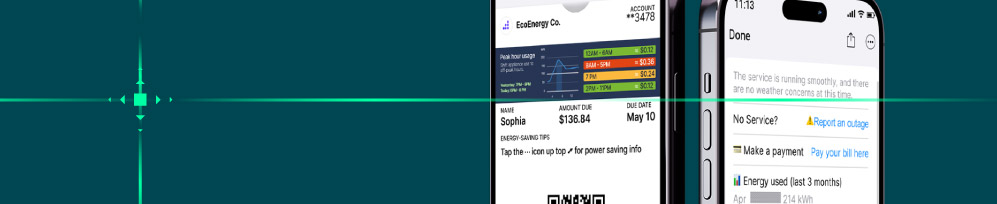
The Digital Wallet Card for Utilities puts billing and usage information directly into a customer’s mobile wallet, so they can see what they owe, when it is due, and how their usage is trending, all in a couple of taps. The card uses intelligent workflows to turn required billing and outage communications into simple, human-centered customer journeys. By turning routine notifications into real-time, in-pocket insights, utilities can help customers stay ahead of their bills rather than catch up after the fact.
A digital wallet card is a mobile card that customers add to their existing Apple or Google Wallet, similar to an airline boarding pass or event ticket. Convey’s Digital Wallet Card for Utilities is purpose-built for energy providers, combining account details, alerts, and one-tap actions in a branded, trusted experience:
Customers add the card via email, SMS, QR code, or a utility portal and access it in two taps; no app, no login, no new password to remember.
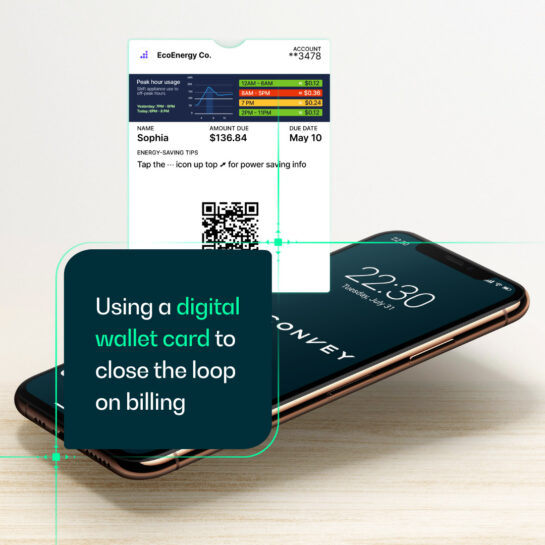
The card can display key information such as account number, amount due, due date, recent usage, payment history, and energy-saving tips.
Utilities can send push notifications through the card for billing, high usage, outages, and weather events, with adoption rates as high as 60% and push open rates nearing 90%, far outperforming email or traditional apps.
These actions turn the mobile wallet into a persistent, everyday touchpoint for affordability support.
Households are under growing pressure from rising utility costs, and many are struggling to keep up. Recent national research shows that about 45% of Americans have paid at least one bill late in the past 12 months, and utilities are the single most common bill to fall behind on. When asked which bills were late, 44% of late payers cited utilities, highlighting that both affordability and organization are drivers of late payments and fees. 1
For lower-income households, the stakes are even higher. Households face “severe” energy burdens and must choose between paying energy bills and other essentials like food and medicine, leaving them especially vulnerable to arrears and shutoffs. Updated energy burden research from the American Council for an Energy-Efficient Economy finds that among the quarter of low-income households with the highest energy burdens, energy bills consume more than 15% of household income. 2
At the same time, customers are showing a clear preference for digital, mobile-first payment tools that help them stay on top of bills. A recent industry report states that 7 in 10 consumers made at least one payment on a phone or tablet in the prior year, and that about 31% of all bill payments are now made on a mobile device. Electronic payment methods and online bill pay account for more than half of bill payments by number, underscoring how strongly customers gravitate toward convenient, digital channels. When utilities offer convenient digital options, including digital wallets, customers can pay “anytime, anywhere,” choose the method that fits their budget, and avoid penalties and service interruptions. 3
Digital wallet cards for utilities sit squarely at the intersection of these trends. By making amounts due, due dates, usage trends, and one-tap payment options visible in the mobile wallet, utilities give customers practical tools to manage energy burdens in real time: reducing forgetfulness, lowering the risk of late fees, and helping vulnerable households stay connected.
Customers often discover they have used “too much” energy only when the monthly bill arrives, leading to bill shock and frustration. Digital wallet cards change that by surfacing usage and cost signals while there is still time to adjust behavior.
When the customer taps, the card shows a simple breakdown of hourly costs, for example:
12 AM–6 AM = $0.12
8 AM–5 PM = $0.36
after 7 PM = $0.24
Making it clear which times of day are most expensive.
The card pairs this with customized tips, such as shifting laundry to off-peak hours, adjusting thermostat settings a few degrees, or enrolling in a peak-hours rewards program that pays customers to reduce usage during grid stress.
Over time, the “energy used last 3 months” view, such as 214 kWh, then 268 kWh, then 189 kWh, helps customers see whether their changes are working. By connecting timely alerts to clear visuals and specific actions, the digital wallet card turns a potential bill shock into an opportunity to lower costs before the bill closes.
For many homeowners, the challenge is not just the bill amount, but also managing timing and avoiding late fees. Paper notices and email reminders are easy to miss and depend on prompt, on-time mail delivery; a digital wallet card in the mobile wallet is much harder to overlook.
Consider a customer juggling rent, childcare, and multiple monthly bills. When the utility bill is ready, a notification pops up from the digital wallet card: “Your bill is ready: $132.88 due by August 5. Tap to review or pay now.”
On the card front, the customer sees “Amount due” and “Due date” at a glance, for example, $136.84 due May 10, so they can quickly decide whether to pay now or plan for the next paycheck. A single tap opens options to view the full PDF bill, make a payment, set up or confirm autopay, or explore the utility’s available support and flexible payment options.
Payment history on the card (for example, $136.84 due in June) provides a simple, phone-friendly record that customers can check when budgeting. Because all this lives in a familiar wallet app, customers can check their utility status in the exact moment they review other spending, making it easier to stay current and avoid unnecessary fees.
Affordability is not only about crisis moments; it is also about giving customers enough information to plan month to month. Digital wallet cards support this by turning historical data and tips into a lightweight budgeting tool customers actually use.
Seasonal transitions, like moving from winter heating to spring or from mild weather to summer cooling, often bring unexpected changes in usage. The digital wallet card’s “last 3 months” usage and bill views help customers see these patterns without logging into a portal.
Utilities can use those same views to feature essential programs, such as efficiency rebates, budget billing, or demand-response offers that help smooth out seasonal bill swings. Energy-saving tips such as setting thermostats to 78°F, unplugging unused devices, or using LED lighting, provide ongoing education that customers can revisit at any time.
Over months, this shifts the relationship from one big monthly statement to many small, helpful touchpoints that reinforce optimized energy habits and better budgeting.
During an unplanned outage, a notification can read: “There is a power outage in your area. Crews are working to restore service. Tap to see updates and estimated restoration time.” The card can then display status updates and links to safety information, reducing the need for customers to call in.
Ahead of a severe storm or high-risk weather day, the card can deliver mobile wallet alerts such as “Severe storm expected today. Be prepared for possible outages. Tap to review safety tips,” directing customers to preparedness content. In wildfire-prone regions, the same card can support planned outage notifications, safety guidance, and restoration updates.
These scenarios reinforce the idea that the digital wallet card is not a single-purpose billing tool but a flexible, always-on channel for critical utility information that continues to support the core goal of customer affordability and stability.
Utilities do not need to rebuild their technology stacks to launch digital wallet cards for affordability and critical alerts. Convey’s deployment strategy is crafted to go from idea to live in under 12 weeks so that benefits can reach customers quickly.
A structured four-step process, selecting card modes, choosing templates, completing data integrations, and launching the first campaign, gets the initial card into customers’ wallets in about 8–12 weeks. Integrations with billing systems (such as CC&B or SAP), outage management, CRM and preference systems, and analytics platforms guarantee that the digital wallet card always reflects authoritative data and customer choices.
Convey’s intuitive, web-based management portal gives utility teams complete control with zero unnecessary complexity. Teams can design and launch cards, configure automation and triggers, and track engagement in real time, including “Added to Wallet” counts and click-through rates. That means utilities can start reducing bill surprises, missed payments, and avoidable call volume within the same planning cycle they decide to modernize their customer experience with Convey’s Digital Wallet Card for Utilities.
If your utility is ready to put critical billing and usage information directly into your customers’ pockets, visit goconvey.com or contact Convey to schedule a demo of the Digital Wallet Card deployment path.