
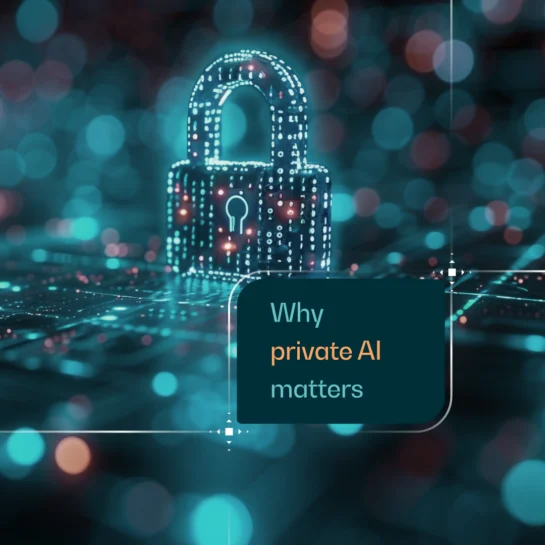

Why private AI matters for utilities and regulated industries

By Paul Watkins
November 4, 2026 9 min read
Share this post
Why private AI matters for utilities and regulated industries
news icon
Why private AI matters for utilities and regulated industries

Artificial intelligence is creating new opportunities for utilities and essential service providers. From improving customer experiences and streamlining operations to helping teams make faster, more informed decisions, AI has the potential to change how regulated industries work and serve their customers.

But as organizations explore these capabilities, an important question deserves just as much attention as what AI can do: Where does your data go, and who has access to it?

For utilities, this is more than a technology consideration. These organizations manage sensitive customer information, billing records, payment details, service addresses, and operational data. They also operate in highly regulated environments where protecting information, maintaining customer trust and meeting compliance obligations are fundamental responsibilities.

Adopting AI should not mean compromising those responsibilities. That’s where private AI becomes important.

The opportunity and the risk of AI adoption

The potential benefits of AI are difficult to ignore. Utilities can use intelligent tools to identify customer needs, improve communication, support employees and make complex processes more efficient.

Consider how AI could help a utility anticipate when a customer may need assistance with a high bill, identify the most relevant next step in a customer interaction or help customer service representatives respond more effectively. These applications can create meaningful improvements for both customers and the teams supporting them.

However, not all AI solutions handle information in the same way.

Some AI services may use shared infrastructure or retain information submitted by users to improve their models, depending on the provider, product and configuration. In certain arrangements, information from one organization may contribute to a model or service used by others.

For organizations handling sensitive customer and operational information, these practices raise important questions:

  • Is customer information being used to train AI models?
  • Can information submitted to the AI tool be accessed by other organizations?
  • Where is data processed and stored?
  • How long is information retained?
  • Who has access to customer data, including third-party providers?
  • What controls are in place to protect information and demonstrate compliance?

These questions should be part of the AI evaluation process, not something organizations address after implementation.

What is private AI?

Private AI refers to AI capabilities designed to operate within controlled environments, with defined protections around how an organization’s data is accessed, processed, stored and used.

Unlike arrangements where information may contribute to shared models or services, private AI prioritizes keeping an organization’s data separate and limiting its use to the purposes authorized by that organization.

The specific protections depend on how a solution is designed and deployed. Private AI is not simply a matter of choosing a product labeled private. Organizations need to understand the underlying architecture, data policies and contractual commitments.

For regulated industries, a meaningful private AI approach should address several key areas:

1. Data isolation

An organization’s information should remain separate from other customers’ data. Organizations should understand where their information lives, how it is processed and what safeguards prevent unauthorized access or exposure.

2. Model training and data usage

Organizations should know whether information submitted to an AI solution, including prompts, customer records and generated outputs, is used to train or improve models. A private AI approach should clearly define these uses and prohibit unauthorized training on sensitive organizational data.

3. Access and infrastructure controls

Where AI runs, who can access it and how information moves through the system all matter. Organizations should understand the infrastructure supporting their AI tools, including cloud environments, third-party providers and subprocessors.

4. Transparency and accountability

Privacy commitments should be documented and verifiable. Contracts, data-flow documentation, security reviews and independent assessments can help organizations understand whether a provider’s practices align with its promises.

These considerations help move the conversation beyond AI capabilities and toward the safeguards that make responsible adoption possible.

Why privacy matters even more in regulated industries

Utilities and other essential service providers operate differently from many businesses. They have a responsibility to protect customer information while delivering services people depend on every day.

That creates several important considerations when introducing AI.

Protecting customer trust

Customers share personal and financial information with their utility because they need reliable access to essential services. They expect that information to be handled responsibly.

As utilities introduce AI into customer-facing processes, they need to understand how customer information is being used and protected. An AI-powered experience should make interactions more helpful and efficient without creating uncertainty about data privacy.

Trust is difficult to build and easy to undermine. Responsible AI adoption starts with respecting the information customers have entrusted to an organization.

Supporting regulatory and compliance requirements

Regulated organizations already operate within complex requirements governing customer information, communications, payments and data security.

Introducing AI creates another layer of consideration. Organizations must evaluate how AI tools interact with existing systems, what information they process and whether their use aligns with applicable regulatory, contractual and internal requirements.

A secure AI strategy should complement an organization’s existing governance and compliance practices rather than introduce unnecessary uncertainty.

Protecting operational and organizational knowledge

Customer information is not the only sensitive data utilities manage. Operational processes, infrastructure information, business intelligence and internal workflows can also provide valuable insight into how an organization operates.

When that information is shared with AI tools, organizations should understand whether it remains exclusive to their environment or can be used elsewhere.

Keeping organizational data under the organization’s control helps protect more than customer privacy. It also protects institutional knowledge and the work that differentiates one organization from another.

Reducing risk as AI adoption grows

AI adoption is unlikely to remain limited to isolated experiments. As organizations find new applications, more teams may begin incorporating AI into daily workflows and customer interactions.

Without clear data governance and security requirements, this expansion can introduce inconsistent practices and additional exposure.

Establishing privacy expectations early gives organizations a stronger foundation for scaling AI responsibly. It also gives IT, security, compliance and business leaders a shared framework for evaluating new capabilities.

Questions every utility should ask its AI providers

Choosing an AI solution requires looking beyond demonstrations and feature lists. Utilities should understand how a provider handles information throughout the entire AI lifecycle.

Before adopting an AI tool, consider asking:

  • Does our data train shared models? Understand whether prompts, uploaded information, outputs or other customer data are used for model training or improvement.
  • Is our information isolated? Ask how the provider separates your organization’s data from other customers’ information.
  • Where does the AI run? Request details about the infrastructure, hosting environment and any third-party services involved.
  • Who can access our information? Understand access controls, administrative permissions and the role of subprocessors.
  • How is information retained and deleted? Ask about retention periods, deletion practices and how those policies apply to AI-generated information.
  • Can the provider document its commitments? Review contractual protections, security documentation, data-flow diagrams and available audit or assessment reports.

The answers should be specific, documented and supported by the provider’s actual technical and operational practices.

A vendor’s privacy policy or marketing language alone is not a substitute for understanding how its AI solution works.

Private AI makes responsible innovation possible

The conversation around AI should not be limited to how much faster, smarter or more efficient an organization can become. It should also address what it takes to adopt these capabilities responsibly.

For utilities, that means finding solutions that bring the benefits of AI into customer and operational workflows while respecting the sensitive information those organizations manage. Private AI offers a way to approach that balance. By establishing clear boundaries around data use, access and model training, organizations can pursue innovation without treating privacy as an afterthought.

The goal isn’t to limit what AI can accomplish. It’s to make sure organizations can take advantage of its capabilities while maintaining control over their information and protecting the people they serve.

All the intelligence. None of the exposure.

As utilities look toward the next generation of customer engagement and operational innovation, the question shouldn’t just be what AI can do. It should be whether they can trust the technology, the provider, and the way their data is handled. That is an important distinction when AI is working in service of essential industries and the communities that depend on them.

Frequently asked questions about private AI

What is private AI?

Private AI refers to AI solutions designed to operate in controlled environments with defined protections for an organization’s data. These protections can include data isolation, restrictions on model training, controlled access and documented data-use policies.

How is private AI different from public AI?

Public AI services are generally designed for broader use across many individuals and organizations. Depending on the service and its configuration, information submitted may be retained or used to improve models. Private AI is designed to provide greater control over how an organization’s information is accessed, processed and used. Organizations should evaluate the specific policies and architecture of each provider rather than assume all public or private offerings operate the same way.

Why is private AI important for utilities?

Utilities manage sensitive customer information, financial records and operational data. Private AI can help organizations establish stronger boundaries around how this information is used while adopting AI capabilities to improve customer experiences, streamline workflows and support employees.

Does private AI mean data is never used for AI training?

Not automatically. Organizations should review the provider’s specific model training policies and contractual commitments. A meaningful private AI arrangement should clearly define whether customer information can be used for training and restrict unauthorized use.

What should utilities look for when evaluating secure AI tools?

Utilities should evaluate data isolation, model training policies, infrastructure, access controls, data retention, third-party access, and contractual protections. Security documentation and independent assessments can also help validate a provider’s claims.

Can utilities use AI without compromising customer privacy?

Yes. With appropriate architecture, governance, access controls, and contractual protections, utilities can adopt AI capabilities while maintaining defined boundaries around customer and organizational information. The key is evaluating privacy and security alongside functionality from the beginning.